Schedule Your Consultation
Pick a date and time that works best for you.


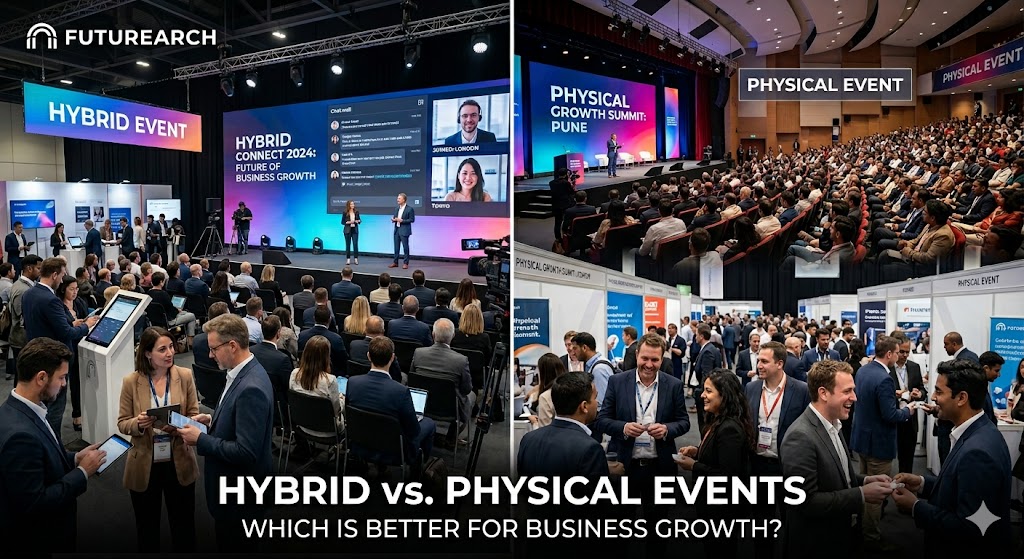
The way we connect with employees, clients, and partners has shifted dramatically over the last few years. While traditional, in-person physical events have always been the bedrock of corporate networking and brand building, hybrid events have stepped up as a massive alternative. By blending the tangible energy of an in-person gathering with the limitless reach of a virtual platform, they offer a completely new playbook.
As organizations pour resources into conferences, product launches, employee engagement programs, and business promotion events, a critical question keeps coming up in leadership meetings: Which format actually drives better business growth?
The truth is, there’s no single right answer. The ideal choice depends entirely on your specific objectives, your audience, your budget, and what success looks like for your organization. To make an informed decision that maximizes your return on investment, you have to look under the hood at the unique strengths and limitations of both options.
Physical events are the classic, in-person gatherings where everyone shares the same physical space. Think of your standard industry trade shows, annual general meetings, product launches, corporate celebrations, and high-stakes executive conferences.
For decades, this was the default setting for corporate gatherings—and for good reason.
The biggest superpower of a physical event is genuine, unfiltered human connection. Face-to-face conversations build deep trust far faster than a pixelated video call ever could. Those spontaneous, unscripted moments—like chatting over coffee during a break or sharing a laugh at a post-conference dinner—are usually where the most valuable partnerships are born.
Furthermore, physical gatherings are incredibly effective for business promotion events because they hit all the senses. Attendees don’t just look at a product on a screen; they can touch it, demo it in real-time, and experience your brand’s personality firsthand.
Hybrid events bridge the gap between two worlds. A core group of attendees meets physically at the venue, while a larger, remote audience participates simultaneously through interactive online platforms.
While this format exploded out of sheer necessity during the pandemic, it has stuck around because the sheer flexibility it offers is too good to ignore. It allows organizations to broadcast their message across cities, countries, and continents without demanding that every single attendee book a flight and a hotel room.
When you want to scale your audience rapidly without blowing out your budget, many top-tier companies for event management will point you directly toward a hybrid model.

The Reach Factor: Hybrid Events Take the Lead
If your primary business goal is pure, unadulterated scale, hybrid events win by a landslide.
A physical event will always be constrained by the laws of physics: venue capacity limits, travel budgets, and calendar availability. Hybrid events completely shatter those geographical boundaries.
Imagine hosting a major industry summit. While your local stakeholders can gather in person, your international clients, remote teams, and global prospects can log in and participate seamlessly from their own desks. This massive scalability makes the hybrid format incredibly valuable for business promotion events where market awareness and sheer audience size directly influence your growth trajectory. When the goal is casting the widest possible net, hybrid is your best bet.
Even with the best tech in the world, you cannot fully replicate the energy of a live room through a computer screen. Physical events excel at creating the emotional resonance that forms the foundation of long-term business relationships.
This emotional impact is especially crucial when you are looking inward at your own team. To build a resilient corporate culture, companies frequently organize annual celebrations, leadership retreats, and dedicated team outing programs.
Taking the time for a well-planned team outing allows employees to completely step away from their daily grinds, drop their guards, and interact like actual human beings rather than avatars on a corporate chat app. These shared live experiences pay massive dividends in employee morale and retention.
When it comes to internal culture, physical events outshine hybrid formats almost every time.
High-impact experiences—like hands-on workshops, leadership challenges, and collaborative problem-solving games—rely heavily on body language, shared energy, and real-time collaboration. This is why organizations invest heavily in targeted team building activities for employees.
Event Type | Core Strength | Best Suited For |
Physical (In-Person) | High-impact emotional connection, deep trust, culture building | Team building activities for employees, strategic offsites, culture-driven retreats, intimate client networking |
Hybrid (Blended) | Mass scalability, data collection, geographic flexibility | Global product launches, massive educational seminars, wide-scale business promotion events |
While virtual trivia nights and online icebreakers served a purpose when we had no other choice, they rarely spark the genuine enthusiasm or deep bonds that come from in-person team building activities for employees. If your goal is to build a hyper-connected workforce, keeping your team events physical is well worth the investment.
Your budget is always going to have a massive say in which direction you choose. However, there is a common misconception that needs clearing up: hybrid doesn’t automatically mean cheap.
A physical event requires heavy investments in the tangibles:
A hybrid event can drastically cut down on your per-head catering and accommodation costs, but it introduces an entirely different set of expenses. To pull off a great hybrid experience, you have to invest heavily in professional live-streaming setups, high-bandwidth venue internet, virtual platform licensing, and dedicated technical support.
Partnering with an experienced event and management company is essential here. They can help you run a realistic cost-benefit analysis so you don’t accidentally overspend on tech or underinvest in the attendee experience.
How you track your ROI looks radically different across these two formats:
Many modern companies for event management leverage these digital data points to help businesses cultivate warm leads long after the event goes dark, turning abstract engagement into tangible sales pipelines.
The decision comes down to a simple strategic pivot:
For many scaling businesses, the ultimate strategy isn’t choosing one and abandoning the other. It’s about building a balanced annual calendar. You might use hybrid formats for your massive, outward-facing market updates, while reserving physical spaces for your internal culture work, targeted team building, and high-value client retreats.
At the end of the day, business growth is fueled by value. Both formats have a distinct, undeniable role to play in modern corporate strategy. Physical events excel at building the deep human trust that secures multi-year contracts and stabilizes teams. Hybrid events give you the megaphone to scale your message to corners of the market you couldn’t otherwise reach.
Whatever path aligns with your current business goals, working alongside a seasoned event and management company takes the guesswork out of the execution. They can help you navigate the logistics, balance your budget, and design an experience that leaves a lasting impression on every attendee—whether they are sitting in the front row of your venue or watching from a laptop thousands of miles away.
