Schedule Your Consultation
Pick a date and time that works best for you.


Pick a date and time that works best for you.
Planning a corporate event can seem simple.
Book a venue. Arrange food. Set up a stage. Invite people. Start the event.
But anyone who has actually planned a corporate event knows that it is rarely that simple.
Behind a two-hour conference, annual celebration, product launch, award night or employee engagement event can be weeks of planning, vendor coordination, rehearsals, technical checks, guest management, branding decisions and last-minute problem-solving.
And in 2026, expectations have changed even more.
Attendees don’t just want to attend an event. They want to feel involved, connected and valued. Businesses also want events to contribute to larger goals such as employee engagement, brand perception, networking, lead generation and customer relationships.
That’s why choosing the right corporate event planner matters.
But how do you know whether an event planner is actually the right fit for your company?
Here is a practical 12-point checklist to help you make a better decision.
Before signing a contract, don’t look only at the planner’s portfolio or presentation.
Look at how they think, communicate, plan, manage problems and measure success.
Experience matters, but relevant experience matters more.
A company may have organized hundreds of events, but that doesn’t automatically mean it is the right choice for your event.
For example, planning a corporate conference, employee engagement event, annual day, product launch, award ceremony, dealer meet, leadership summit or team-building event requires different planning approaches.
Ask the corporate event planner:
The goal is not simply to find an experienced planner. It is to find one whose experience matches your event objective and audience.
This is one of the most important points on the checklist.
Before discussing décor, entertainment or venue options, your event planner should ask:
“What do you want this event to achieve?”
Maybe you want to:
The objective should influence everything that follows.
A conference designed for networking should not feel like an annual celebration. A product launch needs a different experience from an employee offsite.
A good corporate event planner should understand the why before planning the what.
One of the easiest ways to identify a weak event proposal is when the same format seems suitable for every client.
Your company has its own:
Your event should reflect that.
Ask the planner how they would customize the:
Customization doesn’t necessarily mean making everything extravagant.
Sometimes, the smartest event concept is the one that is simple, relevant and memorable.
This is where modern event planning goes beyond logistics.
Ask yourself:
What will the attendee experience from the moment they receive the invitation until they leave the venue?
Consider the complete journey:
Before the event:
Invitation → Registration → Communication → Event information
During the event:
Welcome → Check-in → Sessions → Networking → Activities → Hospitality
After the event:
Feedback → Content → Follow-up → Relationship building
Your corporate event planner should therefore think beyond decoration and create an experience that feels relevant to the people attending.
Technology shouldn’t be included just because it looks impressive.
It should solve a problem.
Depending on the event, useful technology can include:
The right question isn’t:
“Does the planner use AI?”
Ask:
“Where can technology genuinely improve our attendee experience or event outcomes?”
A corporate event involves multiple moving parts.
Depending on the event, your planner may need to coordinate:
A strong corporate event planner should have a reliable vendor network and, more importantly, know how to coordinate those vendors.
Because on event day, “the vendor didn’t arrive” is not an acceptable excuse.
Technical production can make or break a corporate event.
Before hiring an event partner, ask about their approach to:
A professional planner should have a technical checklist and contingency plan rather than relying on everything to “work out on the day.”
A low quotation isn’t always a low-cost event.
Ask for clarity around:
A transparent corporate event planner should explain where your budget is going.
More importantly, they should help you understand where to spend more and where you can save without damaging the attendee experience.
This is one of the biggest differences between planning an event and actually managing an event.
What happens if:
Ask your event planner:
“What is your backup plan?”
Good event planning is not about assuming everything will go perfectly.
It is about being prepared when something doesn’t.
Sustainability is becoming a more practical consideration in event planning—not simply a decorative “green” label.
Depending on the event, ask about:
The important part is to focus on real operational choices rather than simply adding eco-friendly language to the event proposal.
This is a question many businesses forget to ask.
A successful event isn’t necessarily the one with the biggest stage or the most expensive décor.
The right measurement depends on the objective.
For example:
| Event Objective | Possible KPI |
| Employee engagement | Participation & feedback |
| Networking | Meaningful connections |
| Product launch | Leads & engagement |
| Conference | Attendance & session engagement |
| Client event | Relationship & feedback |
| Brand event | Reach & content engagement |
| Training event | Participation & post-event feedback |
Ask your corporate event planner what they can measure before the event begins.
This sounds basic, but it can make your entire experience easier—or extremely stressful.
Your event partner should have clear communication around:
And when the event finally arrives, there should be a team physically managing the execution.
Because the client shouldn’t be running around asking:
“Where is the photographer?”
“Has the speaker arrived?”
“Why isn’t the presentation working?”
“Who is handling the registration desk?”
Your event planner should already know.
A good corporate event planner is no longer just someone who coordinates vendors and books venues.
The role has become much more strategic.
A strong event partner should combine:
Strategy + Creativity + Technology + Experience + Execution + Measurement
They should understand your business objective, create a relevant experience, manage the operational details and help you evaluate the outcome.
That combination is what turns an event from a gathering into an experience.
Before you finalize your event partner, ask these questions:
This helps you understand whether their experience matches your requirements.
Get clarity on responsibilities.
Their answer can tell you a lot about their experience.
Ask for transparent cost breakdowns.
The answer should be based on your requirements—not simply a list of trendy tools.
This shifts the conversation from “How will it look?” to “What will it achieve?”
Planning an event internally may seem cost-effective at first.
But once you consider venue coordination, vendor management, production, guest experience, timelines, rehearsals and event-day execution, the workload can quickly become overwhelming.
A professional corporate event planner brings structure to that complexity.
With the right partner, your internal team can focus on the business and the guests while the event team focuses on making sure everything works behind the scenes.
At FutureArch Events, corporate event planning goes beyond arranging individual event elements.
The focus is on creating experiences around the business objective, audience and brand.
From concept development and venue coordination to branding, production, guest management and on-ground execution, the event is planned as one connected experience.
Whether you’re planning a:
the planning should start with one question:
What should your audience remember when the event is over?
That’s where strategic event planning begins.
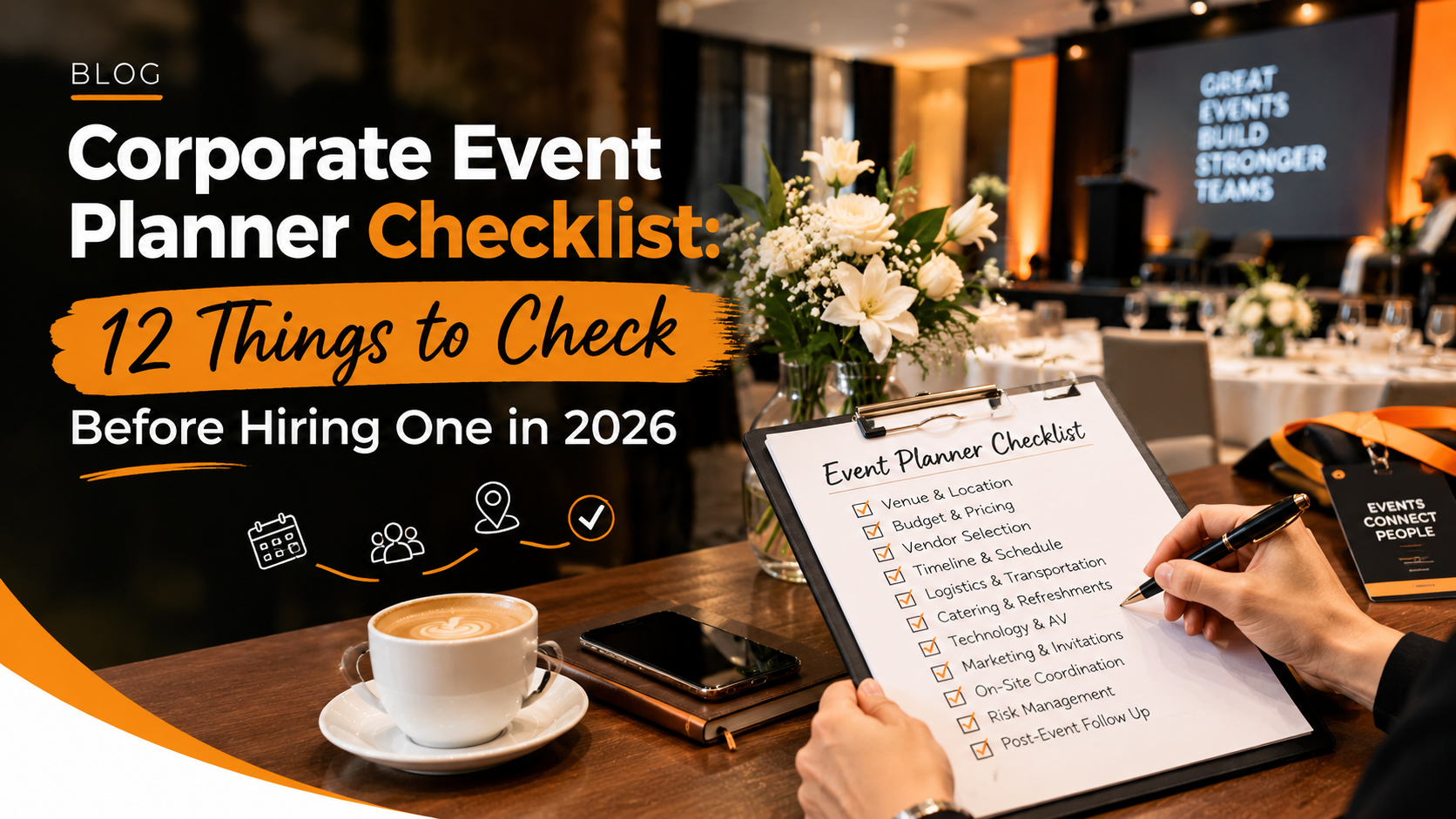
Before hiring your event partner, make sure you check:
☑ Relevant experience
☑ Understanding of your objective
☑ Customized event concepts
☑ Attendee experience
☑ Event technology and AI
☑ Vendor network
☑ Technical production
☑ Budget transparency
☑ Contingency planning
☑ Sustainability approach
☑ Event KPIs
☑ Communication and on-ground execution
Don’t choose a corporate event planner simply because they promise a “grand event.”
Choose one that understands why you’re hosting the event, who you’re hosting it for and what you want the event to achieve.
Because the best corporate events aren’t necessarily the biggest ones.
They’re the ones people remember for the right reasons.
A corporate event planner manages the planning and execution of business events, including concept development, venue coordination, vendors, branding, production, guest management, logistics, entertainment and on-ground execution.
Look at their relevant experience, portfolio, customization capabilities, communication, vendor network, budget transparency, technical expertise, contingency planning and ability to measure event outcomes.
The cost depends on factors such as attendee count, venue, event duration, production requirements, décor, catering, entertainment, technology, logistics and overall event complexity.
A professional planner can reduce the workload on your internal team, coordinate multiple vendors, manage event logistics, handle unexpected issues and create a more organized attendee experience.
Ask about their relevant experience, planning process, services, vendor management, budget structure, technical capabilities, contingency plans, communication process and how they measure event success.
Yes. Businesses planning conferences, employee engagement events, annual celebrations, product launches and other corporate experiences in Pune can work with a professional local event planning team that understands venues, vendors, logistics and on-ground execution.
Hiring a corporate event planner isn’t just about finding someone who can organize an event.
It’s about finding a partner who can understand your objective, translate it into an experience and manage everything required to bring that experience to life.
So before you make your decision, don’t just ask:
“Can you organize our event?”
Ask:
“Can you understand our goal and create an experience that delivers it?”
That’s the question that can help you find the right corporate event planner for your business.
Planning a corporate event in Pune or elsewhere in India? Talk to FutureArch Events and turn your event idea into a professionally planned experience.
Book your free event consultation today.
